
Every student at Beacon Hill brings their own strengths, interests and ways of experiencing the world. Our four learning pathways—Explorer, Traveller, Adventurer and Discoverer—help us provide the teaching, environments and support that enable each student to engage, learn and develop the knowledge and skills they need for their life.
Each pathway offers a particular approach to learning, with carefully planned teaching personalised through each student’s goals. Play-based learning runs across the pathways, taking different forms according to students’ understanding, interests, communication and physical access.
Click on an image below to skip to that section.




Finding the right approach- Engagement for Learning
We look closely at how each student communicates, interacts, explores and understands their surroundings, alongside their sensory and physical needs. Each student has an Engagement Profile, which we build through regular observations across the five areas of engagement. This helps us understand what engagement looks like for that individual and how we can support their learning across different activities and settings.
We also identify what motivates each student, including the activities, resources, environments, levels of support and times of day that help them engage most fully. Together, this information helps us personalise teaching and choose the pathway approach that best supports their learning and progress.
Students can make meaningful progress within any pathway. They may continue in the same pathway or move when a different approach would better support their learning. We review this as our understanding of each student’s interests, strengths and needs develops.
Learning through play
Play may involve movement and interaction with another person, exploring materials, building, pretending or solving a practical problem. Adults plan inviting experiences, join students’ interests, model communication and actions, and extend learning thoughtfully. Repeated opportunities help students build knowledge and skills and use them in different situations. Resources and experiences are age respectful and person appropriate, reflecting each student’s interests, preferences and ways of learning. We value the forms of play that bring them enjoyment and engagement at every stage of their school life.
Early years helps us understand each child’s communication, engagement and learning. All four pathways continue into sixth form, where learning has a sharper focus on adult life.
Cross contextualised embedded learning
Across all pathways, planned learning is woven into everyday routines, play and authentic experiences. Mealtimes, personal care, moving between places and taking part in school and community life provide meaningful opportunities to teach and practise communication, independence, physical skills and emotional regulation. Adults deliberately support this learning, helping students build on familiar experiences and use their skills in different situations
Explorer Pathway Curriculum Overview
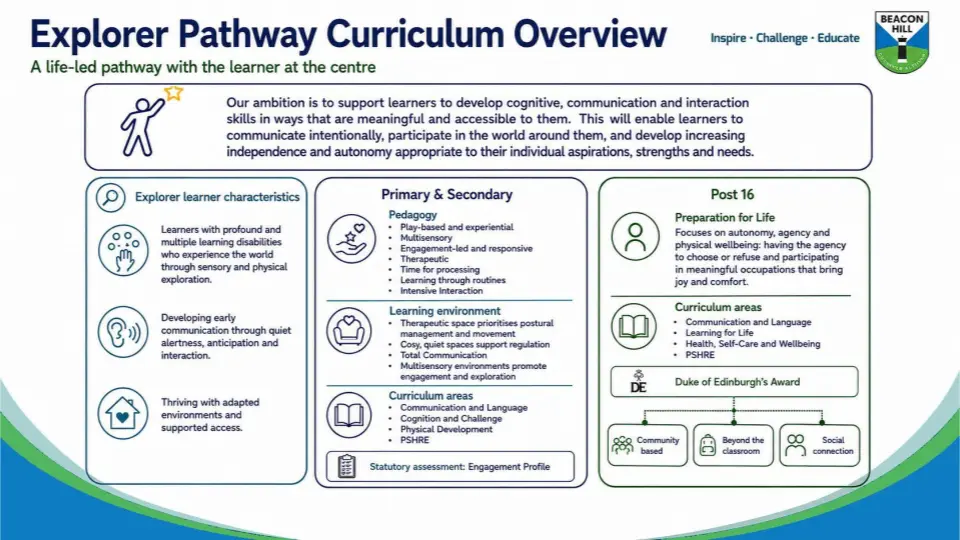
Explorer students learn through sensory experiences, movement, play and relationships. Adults notice subtle responses and use familiar interaction games, sounds, textures and adapted resources to build connection and understanding. Responsive approaches, including Intensive Interaction, support this. Positioning, movement and communication support help students participate comfortably and influence what happens.
Play may involve an exchange of sounds or movements, anticipating a favourite moment or making something happen with an adapted switch. Adults follow students’ interests and allow time for them to respond, explore and initiate.
Planned learning is also woven into familiar routines and shared experiences throughout the day. During personal care, mealtimes, movement and time outdoors, adults help students anticipate what will happen, express preferences and take an active part in ways that are meaningful to them.
Progress might include showing a preference more clearly, initiating an interaction, anticipating a familiar sequence or taking a more active part in an everyday experience.
Read the text
Who this pathway supports
The Explorer pathway supports learners with profound and multiple learning disabilities who experience the world through sensory and physical exploration. Their early communication may be seen in quiet alertness, anticipation and responses to familiar people and experiences.
What we want for our students
Students within the Explorer pathway are developing their thinking, communication and interaction skills. Our aim is to support them to become intentional communicators, interact with their environment with increasing independence and exercise autonomy in a range of contexts.
Learning in sixth form
In sixth form, we continue to support students to make choices, communicate refusal and participate in activities that bring purpose, joy and comfort. Physical wellbeing remains central. Learning includes Communication and Language, Learning for Life, Health, Self-Care and Wellbeing, and PSHRE.
Primary and secondary curriculum areas
During primary and secondary school, students learn through Communication and Language; Cognition and Challenge; Physical Development; and PSHRE. PSHRE is personal, social, health and relationships education.
Experiences beyond the classroom
Community experiences, learning beyond the classroom and social connection remain important in post-16 provision. In sixth form, opportunities include the Bronze Duke of Edinburgh’s Award, with adapted participation.
Assessment
We assess each student’s individual progress and use the formal assessments applicable to them. See Progress and achievement for more information.
Traveller Pathway Curriculum Overview
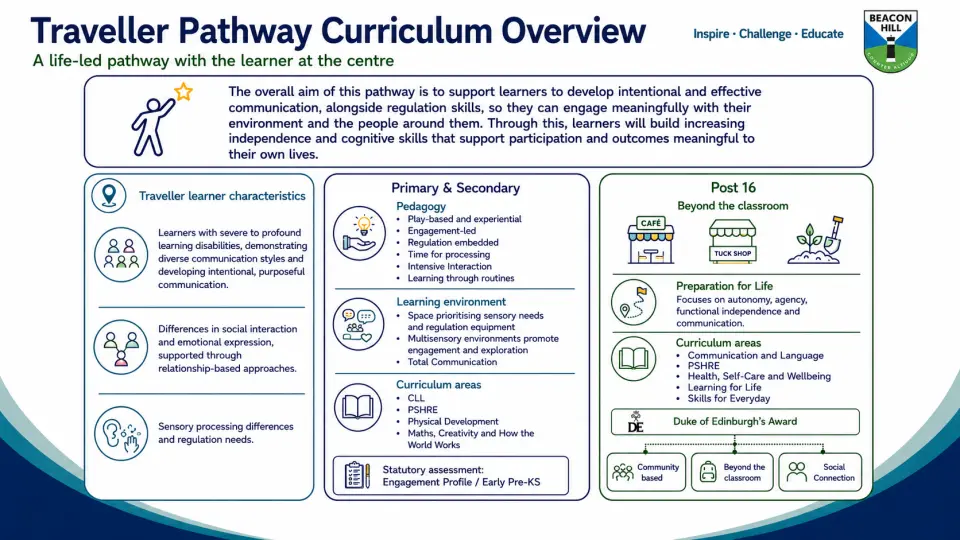
Traveller students learn through practical, sensory experiences, play and interaction. We build on their interests and support their regulation and communication, using familiar routines and allowing time to process. Responsive approaches, including Intensive Interaction, help build connection and shared understanding.
Carefully planned, flexible play opportunities invite students to explore materials, investigate what happens and connect with other people. Adults join students’ play, model communication and offer possibilities that extend exploration at a pace that feels manageable for each individual.
Planned learning is also woven into everyday routines and authentic experiences. Mealtimes, getting ready to go outside, shared activities and visits to familiar places offer meaningful opportunities to communicate, make choices and participate. Adults respond to students’ interests, sensory needs and signals. Through repeated experiences, students build understanding and take a more active part in their day.
Progress might include initiating a familiar game, asking for an activity to continue, exploring a new resource or participating more actively in a routine.
Read the text
Who this pathway supports
The Traveller pathway supports learners with severe to profound learning disabilities who are developing purposeful communication. Students have different ways of communicating and interacting, alongside individual sensory and regulation needs.
What we want for our students
Our aim is to support students to become intentional, effective communicators and to develop regulation with the support they need. This helps them engage meaningfully with their environment and the people around them, with increasing independence, while developing early learning and life skills.
Learning in sixth form
In sixth form, learning supports students to have greater influence over everyday life and to develop communication and practical independence. Curriculum areas include Communication and Language, PSHRE, Health, Self-Care and Wellbeing, Learning for Life and Skills for the Everyday.
Primary and secondary curriculum areas
During primary and secondary school, students learn through Communication, Language and Literacy (CLL); PSHRE; Physical Development; Maths; Creativity; and How the World Works. PSHRE is personal, social, health and relationships education.
Experiences beyond the classroom
Community learning, café, shop and gardening experiences connect learning to real purposes. In sixth form, opportunities include the Bronze Duke of Edinburgh’s Award. Participation is adapted to the individual.
Assessment
We assess each student’s individual progress and use the formal assessments applicable to them. See Progress and achievement for more information.
Adventurer Pathway Curriculum Overview
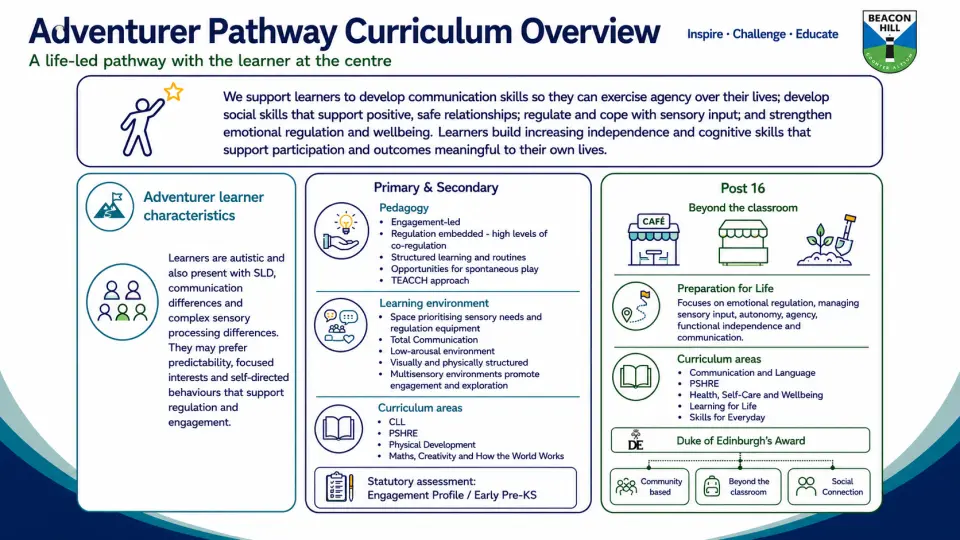
Adventurer students benefit from predictable routines, clear visual information and environments that support their sensory needs. Approaches such as TEACCH help organise spaces and visual information so students can understand what is available and participate with confidence.
We combine structured teaching with practical experiences, play and opportunities to follow individual interests. Adults model actions and communication, support regulation and allow time for processing. Students have opportunities to repeat, explore and extend familiar play experiences.
Planned learning is also woven into everyday routines and authentic experiences. Preparing a snack, organising belongings, moving between spaces and visiting familiar places provide meaningful opportunities to practise communication, make choices and develop independence. Adults use familiar sequences and consistent support to help students use their learning across different activities and settings.
Progress might include making a choice, communicating a need for a break, understanding a familiar sequence or completing part of an everyday activity more independently.
Read the text
Who this pathway supports
The Adventurer pathway supports autistic learners with severe learning disabilities, communication differences and complex sensory processing needs.
What we want for our students
Our aim is to encourage students to engage in broad and rich experiences that are appropriate to their needs. We prepare and support them academically, socially, physically and emotionally for their immediate next steps and adult life, developing communication, regulation, relationships, health, safety, self-care and resilience.
Learning in sixth form
In sixth form, we build on each student’s communication and independence while continuing to support regulation, sensory needs and autonomy. Curriculum areas include Communication and Language, PSHRE, Health, Self-Care and Wellbeing, Learning for Life and Skills for the Everyday.
Primary and secondary curriculum areas
During primary and secondary school, students learn through Communication, Language and Literacy (CLL); PSHRE; Physical Development; Maths; Creativity; and How the World Works. PSHRE is personal, social, health and relationships education.
Experiences beyond the classroom
Community learning, café, shop and gardening experiences connect learning to real purposes. In sixth form, opportunities include the Bronze Duke of Edinburgh’s Award. Participation is adapted to the individual.
Assessment
We assess each student’s individual progress and use the formal assessments applicable to them. See Progress and achievement for more information.
Discoverer Pathway Curriculum Overview
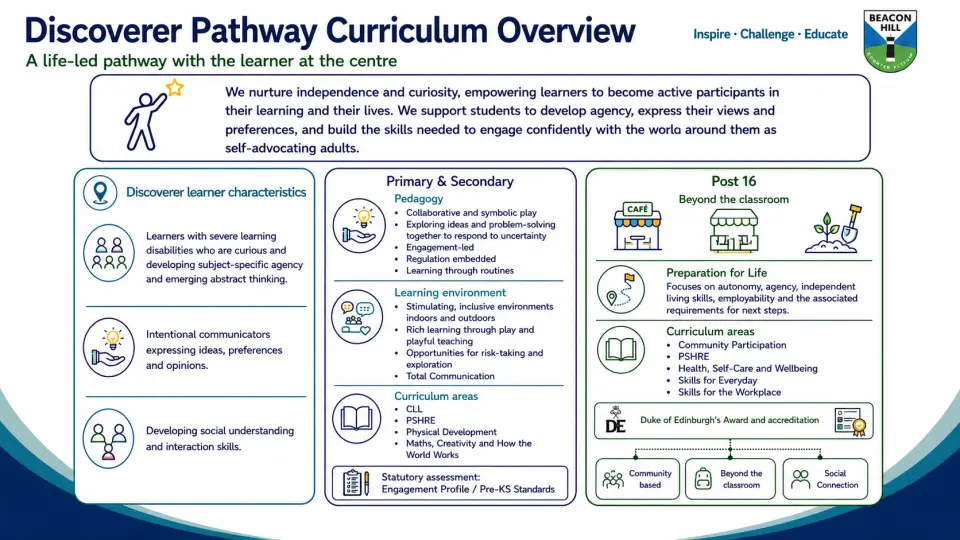
Discoverer students are developing the confidence and independence to choose activities, follow their interests and take an active part in learning. Through play, practical exploration and shared experiences, they build communication, early literacy and mathematical skills, alongside their understanding of the world.
Adults create inviting spaces and purposeful opportunities for learning. They join students’ play, model communication, introduce new ideas and support students to make choices, solve problems and develop their own thinking. Building, small-world play, creative activities and games provide opportunities to explore ideas and learn alongside others.
Planned learning is also woven into everyday routines and authentic experiences. Preparing food, choosing resources, shopping and taking part in the community provide meaningful opportunities to practise communication, literacy, number skills and decision-making. Adults help students connect and use their learning across play, planned activities and everyday life.
Progress might include communicating an idea, finding a solution, sharing play with another student or taking part with greater independence and confidence.
Read the text
Who this pathway supports
The Discoverer pathway supports learners with severe learning disabilities who communicate intentionally and express their ideas and preferences. Students are developing their learning across curriculum areas and beginning to understand more abstract ideas.
What we want for our students
Our aim is to develop students’ independence, agency, curiosity to learn and ability to interact with other people and the world around them. This supports their growing knowledge and skills across curriculum areas and helps them express their views and take an active part in their lives.
Learning in sixth form
In sixth form, learning focuses on everyday living, community participation and skills for work. Curriculum areas include Community Participation, PSHRE, Health, Self-Care and Wellbeing, Skills for the Everyday and Skills for the Workplace.
Primary and secondary curriculum areas
During primary and secondary school, students learn through Communication, Language and Literacy (CLL); PSHRE; Physical Development; Maths; Creativity; and How the World Works. PSHRE is personal, social, health and relationships education.
Experiences beyond the classroom
Community learning, café, enterprise and gardening experiences connect learning to real purposes. In sixth form, opportunities include the Bronze Duke of Edinburgh’s Award and accreditation/qualification where appropriate to the student.
Assessment
We assess each student’s individual progress and use the formal assessments applicable to them. See Progress and achievement for more information.