
Early Years
Read the text
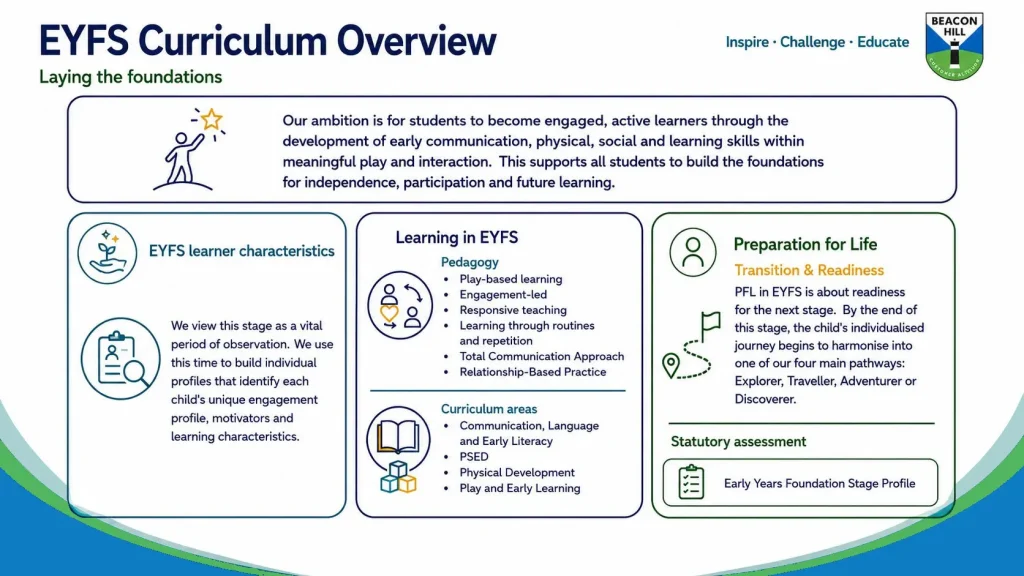
Our ambition for each child
We want children to become engaged, active learners who feel connected to the people and experiences around them. Meaningful play and interaction help develop early communication, physical and social skills, building foundations for independence and participation.
Getting to know each child
We observe how each child engages, what interests and motivates them, and how they approach learning. This helps us understand their starting point and plan experiences that support their next steps.
How children learn
Children learn through play, relationships and responsive teaching. Adults plan inviting spaces and resources, follow children’s interests, model communication and extend exploration through interaction. Play may involve movement or people as well as objects. Our curriculum connects Communication, Language and Early Literacy; Personal, Social and Emotional Development; Physical Development; and Play and Early Learning, with repeated opportunities to revisit learning.
Preparing for the next stage
As we learn how each child communicates, engages and learns, we identify the pathway and approaches that will support their next stage. We complete the EYFS Profile at the end of Reception.
Read the text
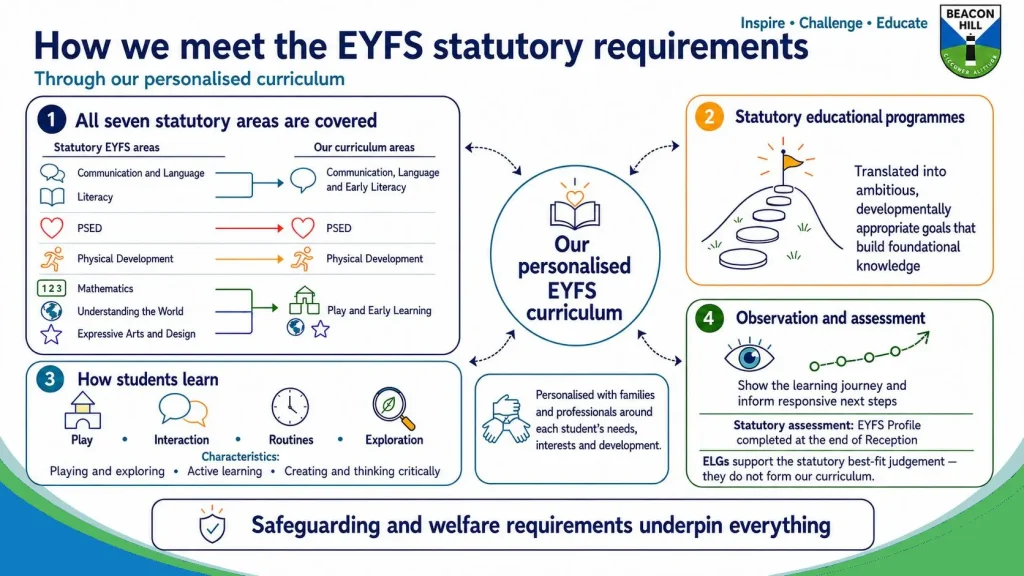
Communication and literacy
We bring the EYFS areas of Communication and Language and Literacy together within our Communication, Language and Early Literacy curriculum. This helps us connect children’s developing communication with the foundations of reading and writing.
Personal and physical development
Personal, Social and Emotional Development and Physical Development each have their own curriculum area. These support children’s relationships, wellbeing, movement and growing participation in everyday life.
Play and early learning
Children explore Mathematics, Understanding the World and Expressive Arts and Design through Play and Early Learning and connected experiences. These areas are woven into opportunities to play, investigate and discover.
Personalised teaching
The statutory educational programmes guide our teaching and help us plan ambitious goals that build foundational knowledge. We personalise learning with families and professionals through play, interaction, routines and exploration. Children are supported to play and explore, stay actively involved, and develop their thinking and ideas.
Observation and assessment
Our observations help us understand each child’s learning and decide what to teach next. We complete the EYFS Profile at the end of Reception. The Early Learning Goals support this statutory judgement; our curriculum provides the wider learning experiences that lead towards it. Safeguarding and welfare underpin all our provision.
Read the text
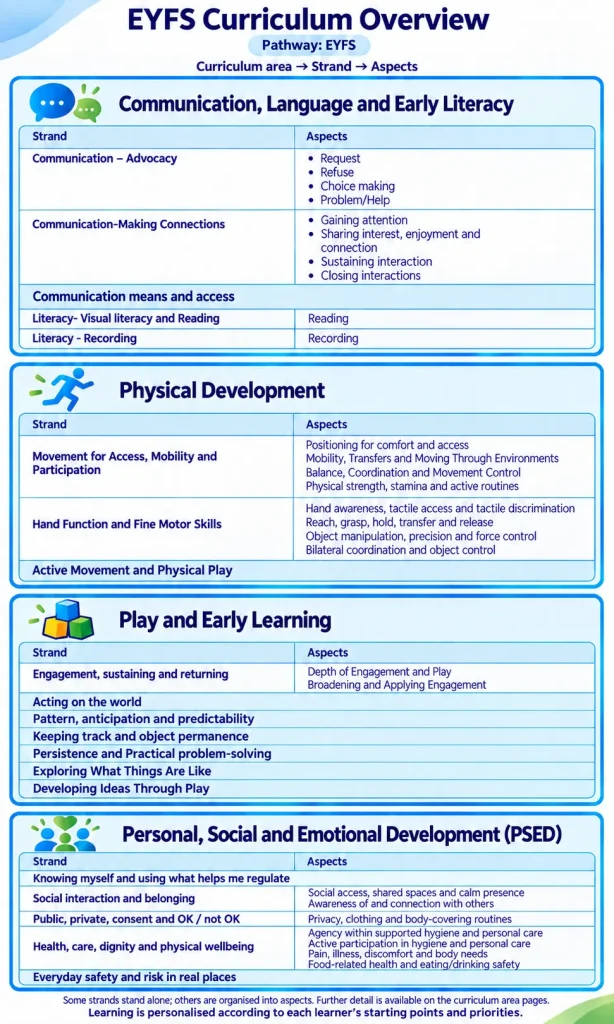
Communication, Language and Early Literacy
Communication – Advocacy
Aspects:
- Request
- Refuse
- Choice making
- Problem/Help
Communication-Making Connections
Aspects:
- Gaining attention
- Sharing interest, enjoyment and connection
- Sustaining interaction
- Closing interactions
Communication means and access
This is a standalone strand.
Literacy – Visual literacy and Reading
Aspect:
- Reading
Literacy – Recording
Aspect:
- Recording
Physical Development
Movement for Access, Mobility and Participation
Aspects:
- Positioning for comfort and access
- Mobility, Transfers and Moving Through Environments
- Balance, Coordination and Movement Control
- Physical strength, stamina and active routines
Hand Function and Fine Motor Skills
Aspects:
- Hand awareness, tactile access and tactile discrimination
- Reach, grasp, hold, transfer and release
- Object manipulation, precision and force control
- Bilateral coordination and object control
Active Movement and Physical Play
This is a standalone strand.
Play and Early Learning
Engagement, sustaining and returning
Aspects:
- Depth of Engagement and Play
- Broadening and Applying Engagement
The following are standalone strands:
- Acting on the world
- Pattern, anticipation and predictability
- Keeping track and object permanence
- Persistence and Practical problem-solving
- Exploring What Things Are Like
- Developing Ideas Through Play
Personal, Social and Emotional Development (PSED)
Knowing myself and using what helps me regulate
This is a standalone strand.
Social interaction and belonging
Aspects:
- Social access, shared spaces and calm presence
- Awareness of and connection with others
- Public, private, consent and OK / not OK
Aspect:
- Privacy, clothing and body-covering routines
Health, care, dignity and physical wellbeing
Aspects:
- Agency within supported hygiene and personal care
- Active participation in hygiene and personal care
- Pain, illness, discomfort and body needs
- Food-related health and eating/drinking safety
Everyday safety and risk in real places
This is a standalone strand.