
Our curriculum in action
At Beacon Hill, we bring the curriculum to life through play, meaningful experiences, everyday routines and quality interactions. Staff plan the knowledge and skills each student needs to learn, then adapt their teaching to help them engage, participate and make progress.
Learning through meaningful experiences
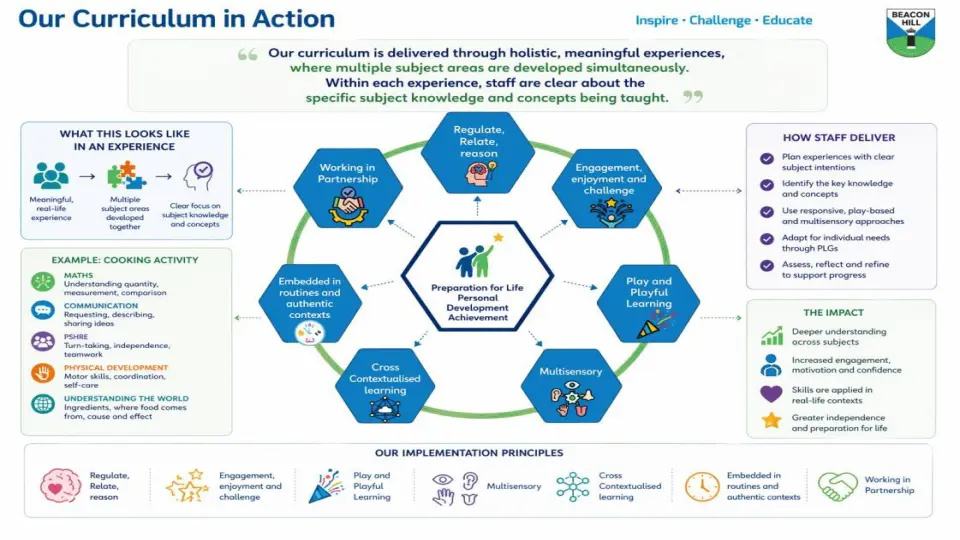
One experience can bring together learning from several curriculum areas. During cooking, for example, students may develop communication, mathematical understanding, physical skills and independence. Each student has their own learning focus and the support they need to participate.
Read the text
Learning across curriculum areas
A meaningful experience can bring several curriculum areas together while giving each student a clear learning focus. Staff identify the knowledge and skills to teach, link these to individual learning goals and use what they observe to plan the next steps.
Learning through cooking
During cooking, students can explore quantities, measurement and comparison. They can practise requesting, describing and sharing ideas, while developing turn-taking, teamwork and independence. Preparing ingredients also offers opportunities to develop movement, coordination and self-care, and to learn where food comes from and how actions lead to changes.
Our teaching principles
Play-based learning is a purposeful part of our planned curriculum. Adults prepare inviting resources and environments, join students’ interests, model communication and extend learning through interaction. Play can involve movement, sensory exploration, construction, imagination or shared problem-solving. We support regulation and revisit learning across play, activities and routines, working with families and professionals to understand each learner.
What this makes possible
We want students to deepen their understanding, grow in confidence and take a more active part in learning. By using their skills in real situations, they build independence and prepare for the experiences and opportunities ahead.
Planned learning throughout the day
We recognise the power of the everyday. Interactions and experiences offer many opportunities to support students’ goals and aspirations. Staff plan for these through lessons, play, routines and personal care, and respond to those that arise naturally. A clear learning focus makes repetition meaningful and connects learning to real life.
Adults model communication and actions, allow time for students to respond and adjust support to help them participate. Repeated opportunities across the day help students develop and use their learning with different people and in different situations.

Read the text
Understand the journey
Staff know the learner’s starting point, longer-term direction and the steps that connect them. They understand how the current learning contributes to the student’s life.
Know the focus
Staff know the specific knowledge or skill being taught in an experience or routine. They plan opportunities to teach and practise it throughout the day and recognise relevant opportunities that arise naturally.
Interact
Adults connect with the student, join their interests and respond to their communication. Interaction is part of teaching across lessons, play and everyday routines.
Model without expectation
Adults demonstrate communication and actions without requiring an immediate copy. Students can observe and experience the model repeatedly.
Give time and respond
Adults pause to allow processing and respond to the student’s contribution, including subtle changes in movement, expression or attention.
Give the appropriate amount of support
Adults adapt help, resources and access so that each student can participate actively. They adjust support as understanding and skills develop.
Share what changed
Staff share what the student now understands or can do, the support they needed and the conditions that helped. This informs the next steps and helps others support learning consistently.